Course Details
Home> Course Details
Robotics Programming Essentials
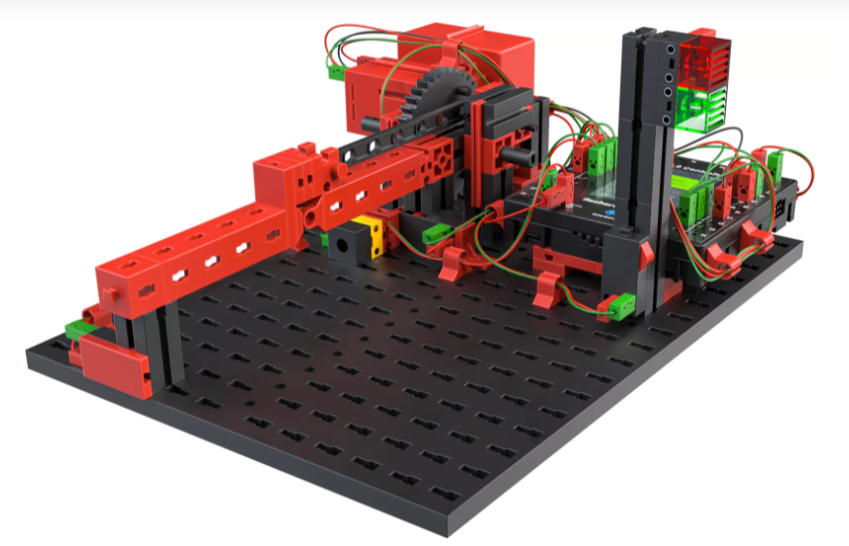
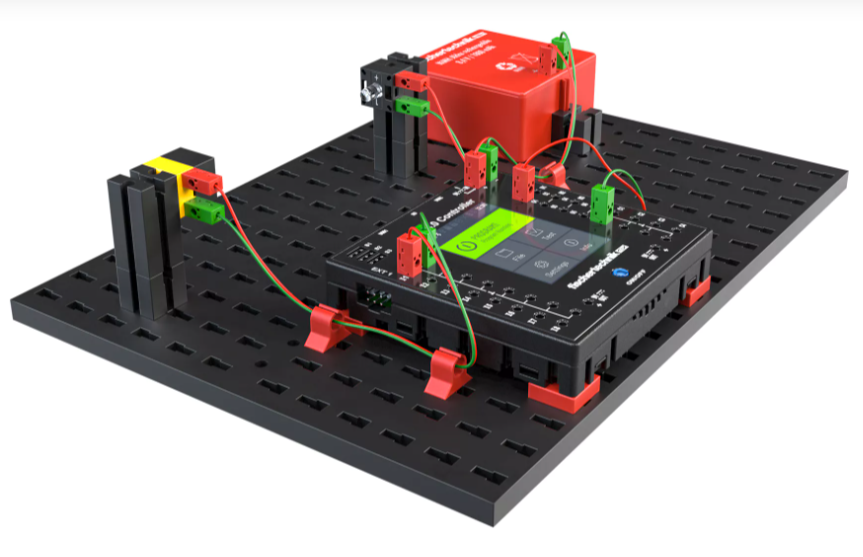
Robotics Programming Essential
Throughout the course, students will also explore important programming principles such as state machines, parallel processing, and communication protocols including coding and encryption techniques. By building and programming different robot models—from obstacle-avoiding buggies to drawing robots and track followers—students develop strong problem-solving abilities and practical experience with real robotic systems. This foundation prepares them for advanced robotics studies or careers in automation, programming, and engineering.
Learning Outcomes
- Understand rotational motion, center of mass, and stability principles.
- Identify and explain simple machines and mechanical advantage.
- Define key terms: magnetism, electromagnetic induction.
- Identify electronic components (resistors, capacitors, transistors, microcontrollers).
- Understand modulation types (AM, FM, PWM) and signal modulation.
- Understand projectile motion and energy transfer.
- Explain principles of structure stability and mechanical designs.
- Understand projectile motion and energy transfer.
- Explain principles of structure stability and mechanical designs.
- Recall principles of wind turbines and power transmission concepts.
- Investigate factors affecting wind turbine performance.
- Understand principles of motion and stability.
- Define elastic potential energy and force in catapults.
- Explain storage and release of elastic potential energy.
- Identify components for alarm system circuit design (Arduino, sensors, LEDs, etc.).
- Construct and evaluate alarm system circuit on a breadboard.
- Design a circuit to display temperature values on an LCD.
In this lesson, students will learn about the basics of Arduino UNO and Tinkercad simulator. They will also learn about syntax based programming in C++ and design different LED patterns
Students will design series and parallel circuits and calculate current and voltages across these
This lesson focuses on building circuits using AND, OR, and NOT gates. Students will learn about unit conversion. Father more over students will learn about calculations of currents and voltages.
Students will learn about magnetism. they will be able to design a security system using Pushbuttons, LEDs and Buzzers.
Students will be able to understand Arduino's Analog-to-Digital Converter (ADC) function. Students will learn about principles of structure stability and mechanical designs and become enough capable to apply conservation of energy in launching mechanisms.
Students will work on brightness control on a LED by using a potentiometer.
- Define and explain the principles and significance of serial communication
- Identify and describe the key components of UART, including baud rate, start bits, stop bits, and parity bits
- Implement UART communication protocols using Arduino programming and Tinkercad simulations, applying theoretical knowledge in a practical context.
Students will
- understand how robots integrate motion and stability principles.
- apply functions to measure temperature
- print the measured temperature on Serial monitor
Students will be able to identify components for alarm system circuit design (Arduino, sensors, LEDs, etc.). They will construct and evaluate alarm system circuit on a breadboard using smoke sensor.
Students will be capable to
- Design a circuit to display temperature values on an LCD.
- Understand the components and connections required for the circuit.
- Learn to interface temperature sensors with LCD displays using microcontrollers. Students will be evaluated by the basis of their prier knowledge.