Course Details
Home> Course Details
Introduction to Astronomy



Course Overview
This course takes students on a journey through the vast expanse of the universe, exploring the wonders of astronomy and our place within the cosmos. The course covers a broad range of topics, including the solar system, stars, galaxies, and cosmology. Students learn about the history of astronomy, from ancient civilizations to modern-day breakthroughs, and gain a deeper understanding of the universe and its many mysteries.
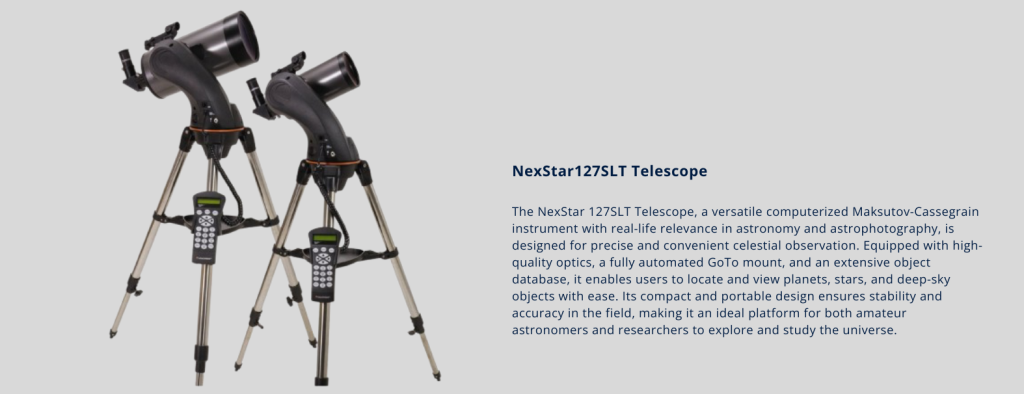
Through a combination of lectures, hands-on activities, and projects, students develop essential skills in critical thinking and problem-solving. They learn about astronomical tools and techniques, including telescopes, spectroscopy, and interferometry, and apply these concepts to real-world problems and phenomena. The course also delves into the latest discoveries in astronomy, including exoplanets, black holes, and the search for life beyond Earth.
By the end of the course, students will have a comprehensive understanding of astronomy and its many applications. They will be able to describe the structure and evolution of the universe, analyze and interpret astronomical data, and think critically about complex astronomical concepts. Through collaborative projects and activities, students will also develop practical skills in astronomical observation and data analysis, preparing them for further study or careers in the field of astronomy.
Learning Outcomes
By the end of the course, students will be able to:
- Explain the significance of astronomy in understanding the universe.
- Differentiate between observational and experimental science.
- Describe how scientific models of the universe evolve over time.
- Interpret astronomical distances using light-years and the speed of light.
- Apply scientific notation to express large astronomical values.
- Describe the scale and structure of the solar system, galaxies, and the observable universe.
- Explain light travel time and its importance in observing the cosmic past.
- Recognize and explain the universality of scientific laws using mathematical principles.
- Identify major celestial bodies and their relative positions in the solar system.
- Construct and interpret scaled models of the solar system to visualize distances.
- Distinguish between galaxies, clusters, and superclusters in the large-scale structure of the universe.
- Explain the structure of matter at the atomic level and its relationship to the emptiness of space.
- Summarize the role of fundamental forces in the formation and behavior of matter.
- Describe the features of the celestial sphere and use the astronomical coordinate system to map the sky.
- Operate a refracting telescope to observe, focus on, and record distant astronomical objects accurately.
- Students will learn about the two ways of studying astronomy.
- They will get to know about astronomical units and how they are calculated.
- Students will be able to know about distances and their units in space.
- They will learn to convert metric units to scientific notation.
- Students will make planets from arts supplies according to their actual shape and size.
- They will position them according to their actual distance from the sun.
Students will be able to:
Draft their own cosmic year.
- Learn about the universe's history, long before the creation of humans.
Students will be able to:
- Differentiate between the various constellations on the ecliptic.
Understand the celestial poles and sphere.
- Experience the Earth's view from above with the help of a VR Headset.
- Students will learn about the contributions of various astronomers from around the globe to the growth of astronomy.
- They will understand the importance of the horoscope and its invention.
- Students will discover the contributions of Copernicus and Galileo to modern astronomy.
- They will research any two of history's most famous astronomers and present their findings.
Students will study the history of the laws of planetary motion.
- They will be able to solve problems related to the physics of planetary motion.
- Students will be given different tasks based on their prior knowledge to be evaluated.
- Through the evaluation, students will be able to present their learning and experience in a presentation.
Courses

Meet Our Teacher

Name: Mian Ali Shafiq
Designation: Master Trainer
Experience: 10 years
Mian Ali Shafiq is a skilled Electrical Engineer with a Bachelor’s in Electronics and Communication from the University of Lahore. His expertise spans tools like MATLAB and programming in C++. Alongside his technical background, he holds a Master’s in Education Sciences from the University of Strathclyde. Glassgow and an MBA in Finance from UET. Ali has served as a Subject Head and Coordinator at Crescent Model Higher Secondary School and is currently a Master Trainer at Crescent Emerging Technologies Center (CETC), where he trains students in robotics and technology. His work combines engineering expertise with a strong commitment to education.